Republic of the Animals
The Republic of the Animals is the utopian ideal that animates the Rebellion on Animal Farm, a vision of a future society in which animals govern themselves, free from human exploitation. First articulated by Old Major in his speech to the assembled animals, it promised a world where the produce of their labor would be their own, where they would be rich and free, and where the green fields of England would be trodden by beasts alone. This vision was given symbolic form in the green flag that Snowball created from an old tablecloth, painting on it a hoof and a horn to signify the future Republic of the Animals that would arise when the human race had been finally overthrown. The flag was hoisted every Sunday morning, and the singing of 'Beasts of England'—the anthem of the coming republic—became the central ritual of the farm's collective life.
Origins and Early Promise
The Republic of the Animals was born from Old Major's revolutionary teaching. In his speech, he declared that the soil of England was fertile and capable of affording food in abundance to an enormously greater number of animals than then inhabited it, and that the single farm could support a dozen horses, twenty cows, and hundreds of sheep living in comfort and dignity. The root of all misery, he argued, was Man, the only creature that consumes without producing. The solution was Rebellion: to overthrow the human race and establish a society where all animals are equal, where no animal tyrannises over his own kind, and where the produce of their labour belongs to them. This vision inspired the more intelligent animals to prepare for the Rebellion, and the pigs—Snowball, Napoleon, and Squealer—elaborated Old Major's teachings into a complete system of thought called Animalism. The early days after the successful expulsion of Mr. Jones seemed to fulfill the promise: the animals worked joyfully, the harvest was the biggest the farm had ever seen, and every mouthful of food was an acute positive pleasure because it was truly their own.
Symbolic Representation and Ritual
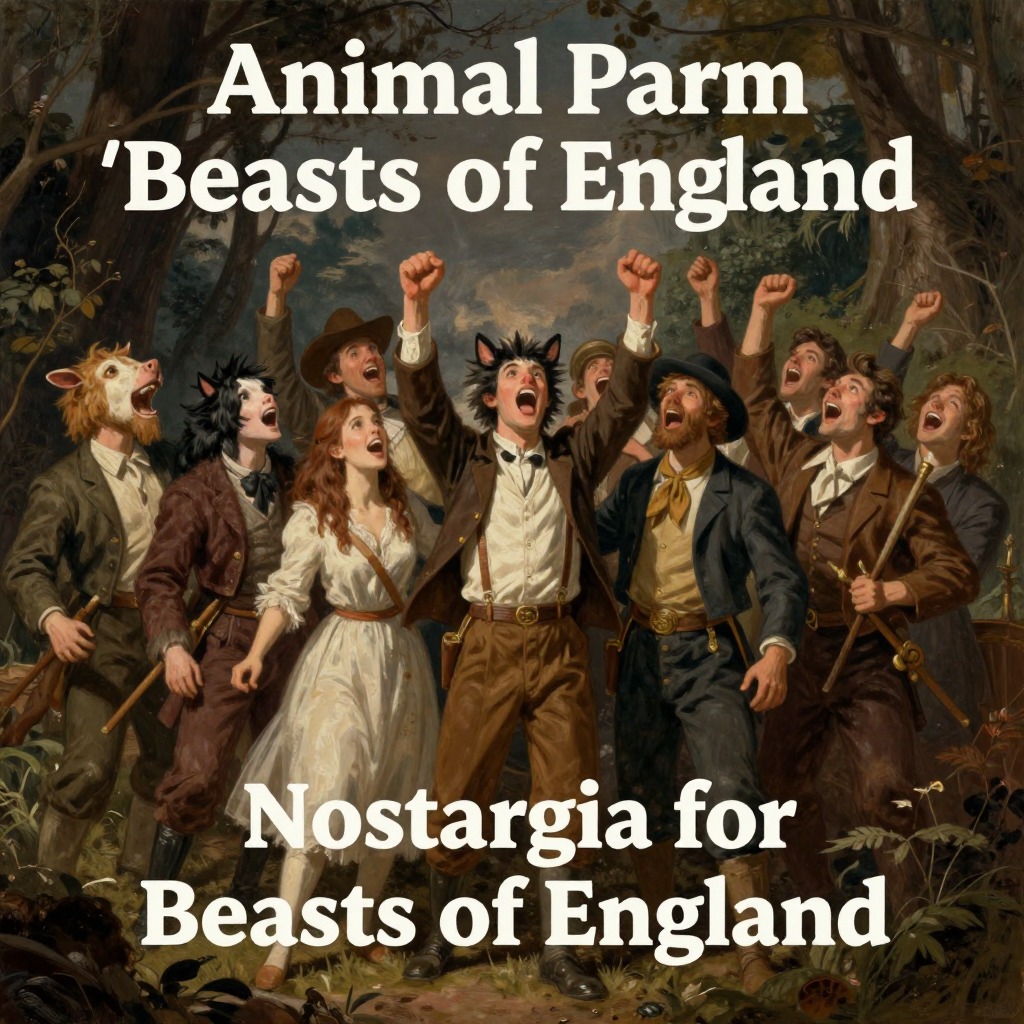
The Republic of the Animals was given concrete symbolic expression through the green flag. Snowball explained that the green represented the green fields of England, while the hoof and horn signified the future Republic of the Animals. This flag was run up the flagstaff in the farmhouse garden every Sunday morning, and the animals trooped into the big barn for a general assembly known as the Meeting, where the work of the coming week was planned and resolutions were debated. The meetings always ended with the singing of 'Beasts of England', the song that Old Major had taught them, which spoke of the golden future time when Tyrant Man shall be o'erthrown and the fruitful fields of England shall be trod by beasts alone. The song became a powerful unifying force, spreading across the countryside and striking fear into human hearts, who heard in it a prophecy of their future doom.
Erosion and Betrayal
As Napoleon consolidated power, the ideals of the Republic of the Animals were systematically eroded. The Sunday-morning Meetings were abolished, and decisions were made by a special committee of pigs presided over by Napoleon. The Seven Commandments, which had been inscribed on the wall as an unalterable law, were gradually altered to justify the pigs' privileges: the Fourth Commandment was amended to allow sleeping in beds without sheets, the Sixth to permit killing with cause, and the Fifth to allow drinking alcohol to excess. The pigs moved into the farmhouse, began to wear clothes, and eventually took to walking on their hind legs. The green flag itself was altered: the white hoof and horn were removed, leaving it a plain green flag. The name 'Animal Farm' was abolished, and the farm was renamed 'The Manor Farm'—its original, human name. The Republic of the Animals, which had been the goal of the Rebellion, was thus erased, replaced by a tyranny in which the pigs, now indistinguishable from the human farmers they had overthrown, ruled with whips and dogs.
Final Disillusionment
By the end of the novel, the Republic of the Animals exists only as a memory, and even that memory is fading. The animals who remember the old days before the Rebellion are few: Clover, Benjamin, Moses, and a number of the pigs. The younger animals, born after the Rebellion, know it only as a dim tradition. The farm is more prosperous, but the animals themselves are not richer; they work long hours on insufficient food, and the luxuries that Snowball once promised—electric light, hot and cold water in every stall, a three-day week—are no longer talked about. Napoleon has denounced such ideas as contrary to the spirit of Animalism, declaring that the truest happiness lies in working hard and living frugally. Yet the animals never give up hope entirely; they still believe that the Republic of the Animals, which Old Major foretold, is coming someday, even if not in their lifetimes. The final image of the novel, however, shows the pigs and the human farmers playing cards together, their faces indistinguishable, and the last remnant of the original ideal—the Seventh Commandment, 'All animals are equal'—has been rewritten to read 'All animals are equal but some animals are more equal than others.' The Republic of the Animals has become its opposite.